Washi, Wax, and Wonder: The Family That Has Been Lighting Up Inasayama for Three Centuries
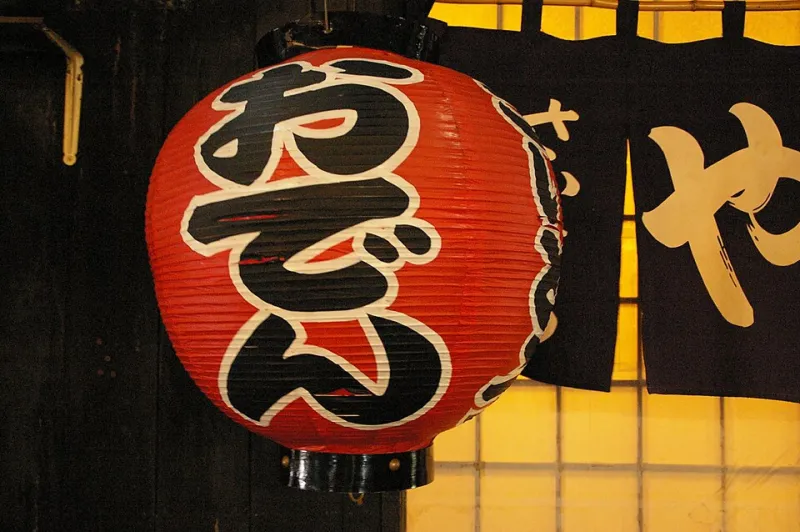
Photo: peno4 from Yakitori izakaya Saito in Okuzawa, Setagaya, Tokyo, CC BY-SA 2.0, via Wikimedia Commons
There's a moment — and if you've ever stood inside the Fujishiro workshop at dusk, you know exactly the one — when the overhead fluorescents click off and the room fills with nothing but the warm amber pulse of a dozen paper lanterns. It lasts maybe three seconds before someone flips the lights back on. But in those three seconds, you understand everything.
The Fujishiro family has been making chōchin — traditional Japanese paper lanterns — from their home workshop on the lower slopes of Inasayama for roughly 300 years. That's not a marketing estimate. That's documented. A handwritten ledger from 1724, now stored under glass in the corner of the family's showroom, records the sale of twelve lanterns to a local shrine ahead of the Obon season. The handwriting belongs to an ancestor whose name, Fujishiro Kenzo, is the same as the man who greeted us at the door on a humid Tuesday morning.
"People ask if it gets strange, sharing a name with someone from 300 years ago," says Kenzo, the seventh generation to lead the workshop, pouring barley tea into mismatched cups. "I think it would be stranger not to."
What Goes Into a Lantern That Lasts
If you've only ever encountered Japanese lanterns as restaurant décor or festival souvenirs, the Fujishiro process will recalibrate your expectations pretty fast. A single premium lantern — the kind commissioned for shrine festivals or formal ceremonies — can take between 12 and 40 hours to complete, depending on size and complexity.
The frame starts with madake bamboo, which Kenzo sources from a supplier in Kyushu. Each strip is hand-split, then soaked overnight before being coiled into the lantern's skeleton. The paper — washi, hand-pressed from mulberry fiber — is applied in sections using a rice-paste adhesive that Kenzo's daughter Rina makes fresh every morning. "Store-bought paste changes the way the paper absorbs light," she explains, not defensively, just factually. "You can feel the difference when you hold it up."
The calligraphy and painted motifs come last, applied with brushes that Kenzo has been using for over two decades. Some designs are inherited patterns, passed down through the ledger system the family has maintained for generations. Others are new — commissions from clients who want something personal, something that bridges the old visual language with a contemporary sensibility.
Adapting Without Apologizing
Here's the thing about tradition: it only survives if someone is willing to have a real conversation with the present. The Fujishiros figured that out a generation ago, when Kenzo's father began accepting custom commissions from interior designers in Tokyo and Osaka. Today, those commissions come from as far away as Portland and Brooklyn.
Rina, who studied design in Fukuoka before returning to Inasayama, handles most of the international inquiries. She's built a quiet but loyal following on social media by posting process videos — not the polished, aesthetic-first content that dominates the craft space online, but genuine workshop footage. Bamboo splitting. Paste mixing. The moment a lantern catches its first light. "American customers especially respond to the process," she says. "They want to know it's real. That someone's hands made it."
And they do. The workshop's online shop ships to the US regularly, and Rina estimates that roughly a third of their international orders come from Americans who either visited Nagasaki and made the trip up to Inasayama, or found the workshop through someone who did.
Why This Resonates Right Now
There's something quietly countercultural about a family that has spent 300 years doing the same thing with their hands. In a moment when so much of American cultural consumption is mediated through screens — algorithmically served, instantly available, infinitely replaceable — the Fujishiro lanterns represent something that genuinely can't be replicated by a factory or an AI.
The spiritual dimension matters here, too. These lanterns weren't originally decorative objects. They were made to guide the spirits of the dead home during Obon, to illuminate shrine pathways, to mark the boundaries between the ordinary world and something larger. That history is embedded in the object itself, in the way the light moves through handmade paper in a way it simply doesn't through synthetic alternatives.
"I think Americans are hungry for things that have a reason behind them," Rina says. "Not just a story you read on a label, but a real reason. Something that goes back further than a marketing campaign."
She's not wrong. The lantern-making workshops the Fujishiros now offer — introduced about four years ago, initially as a local tourism experiment — book out months in advance. Most participants are international visitors, a significant chunk of them American. They come to fold paper and bend bamboo for an afternoon, but what they leave with is harder to quantify than a souvenir.
Keeping the Light Moving Forward
Kenzo's youngest son, fourteen-year-old Daichi, is already learning the bamboo-splitting technique. He's also, notably, the one who set up the workshop's YouTube channel. The family doesn't see any contradiction there.
"The lantern is the same," Kenzo says, setting a finished piece on the table between us. It glows steadily, warmly, without flickering. "What changes is how people find their way to it."
That feels like the right metaphor for what the Fujishiros have actually accomplished — not the preservation of a static artifact, but the maintenance of a living practice that keeps finding new people to illuminate. Three hundred years in, the light hasn't dimmed. If anything, it's reaching further than ever.