Paper, Fire, and Forgiveness: The Festival Traditions That Make Nagasaki Glow
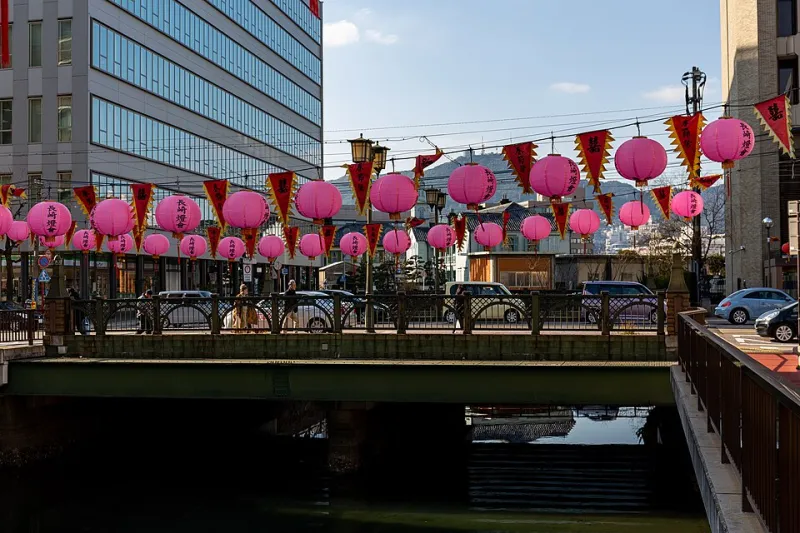
Photo: Balon Greyjoy, CC0, via Wikimedia Commons
There's a moment, usually somewhere around midnight, when you're standing in a narrow Nagasaki alley and the lanterns are so thick overhead that the sky disappears. The air smells like incense and fried tofu. Someone nearby is playing a shamisen. And somehow, despite being thousands of miles from home and completely unable to read the signs around you, everything feels oddly still.
That's the Nagasaki Lantern Festival doing its thing.
For a lot of American travelers, Japan's festival scene begins and ends with Kyoto's Gion Matsuri or Tokyo's Sumida River fireworks. Gorgeous, sure — but also absolutely packed. Nagasaki offers something different. Its celebrations tend to be quieter in crowd size but richer in layered meaning, shaped by a history unlike anywhere else in the country. Once you understand what's behind the lights here, it's hard to look at them the same way.
A City That Has Always Lit Candles in the Dark
Nagasaki's relationship with illumination runs deep, and it's not accidental. For much of Japan's feudal era, Nagasaki was the only port open to foreign trade — a tiny crack in an otherwise sealed country. Chinese merchants, Dutch traders, Portuguese missionaries, and Japanese fishermen all crowded into this small harbor city, and they brought their customs with them. Festivals became a way of coexisting, of saying we are all here, and we acknowledge each other.
That spirit never really left. When you watch a Nagasaki festival today, you're watching centuries of careful cultural negotiation play out in silk, fire, and drumbeats.
The Lantern Festival: More Than a Photo Opportunity
The Nagasaki Lantern Festival — held each year during the Chinese Lunar New Year, typically in late January or February — is the city's most visually dramatic event. Roughly fifteen thousand lanterns transform the Shinchi Chinatown district and the surrounding neighborhoods into something that looks like a dream sequence from a Wong Kar-wai film.
But it's worth slowing down past the Instagram reflex. The festival traces its roots to the Chinese community that has called Nagasaki home for over four hundred years. Originally a private celebration within Chinatown, it gradually opened to the wider city and has since grown into one of western Japan's major winter events. The dragons that wind through the streets aren't decoration — they're protective figures, blessing the city for the year ahead.
What makes the Nagasaki version distinct from, say, San Francisco's Lunar New Year parade is the density of belief behind it. Buddhist temple rituals, Shinto prayers, and traces of the old Christian underground community all coexist in the festival's orbit. You'll find paper lanterns shaped like lotuses (a Buddhist symbol of rebirth) hanging just a few blocks from a church that once sheltered secret Catholics during the Edo-period persecutions. Nobody finds this strange. In Nagasaki, it's just Tuesday.
Obon on the Water: When Grief Becomes Beautiful
If the Lantern Festival is Nagasaki at its most jubilant, the Obon season in August shows its more contemplative side. Obon is a Buddhist tradition observed across Japan — a period when the spirits of ancestors are believed to return to the living world. Families clean graves, light incense, and perform the Bon Odori dance.
In Nagasaki, Obon carries an additional weight that most American visitors aren't prepared for. The atomic bombing of August 9, 1945, falls almost exactly during the Obon period. The city has never quite separated the two. The paper lanterns floated on the harbor each summer carry both the names of ancestors and, implicitly, the memory of those lost in a single morning nearly eighty years ago.
Watching those lanterns drift out into Nagasaki Bay at dusk is one of the more quietly devastating experiences you can have as a traveler. There's no performance to it. People aren't doing it for an audience. They're just sending light out toward something they can't quite reach.
Nagasaki Kunchi: The Festival That Refuses to Be Categorized
Held every October, Nagasaki Kunchi is the city's oldest and most structurally unusual festival. It's officially a Shinto celebration honoring the Suwa Shrine, but its DNA is all over the place in the best possible way. The famous Oranda Manzai — Dutch-style performance dances — were introduced by the Dutch traders at Dejima. The enormous ship floats called Ja-odori (dragon boat dances) reflect the Chinese maritime influence. Even the Portuguese word obrigado (thank you) has allegedly been absorbed into local festival vocabulary over centuries of contact.
For American visitors who grew up with the melting-pot mythology of cities like New Orleans or New York, Nagasaki Kunchi will feel oddly familiar — a place where culture gets remixed not through erasure but through genuine exchange. It's messy and loud and occasionally hard to follow, and that's exactly the point.
Why Now Is a Good Time to Go
Nagasaki has been on the radar for thoughtful travelers for a few years now, but it still hasn't hit the saturation point of better-known Japanese destinations. Festival season here — whether you're targeting February's lanterns, August's Obon observances, or October's Kunchi spectacle — means you're moving through streets with actual locals, not just other tourists trying to get the same shot.
The city also has the infrastructure to handle visitors well. Hotels in the Inasayama area offer elevated views of the harbor that are genuinely worth the uphill walk. And because Nagasaki's festival culture is so layered, even a single visit tends to leave people wanting to come back at a different time of year, for a different celebration, to catch another piece of the story.
The lights here aren't just pretty. They mean something. That's rarer than it sounds.