Slow School: The American Creatives Ditching Their Careers to Apprentice in Nagasaki
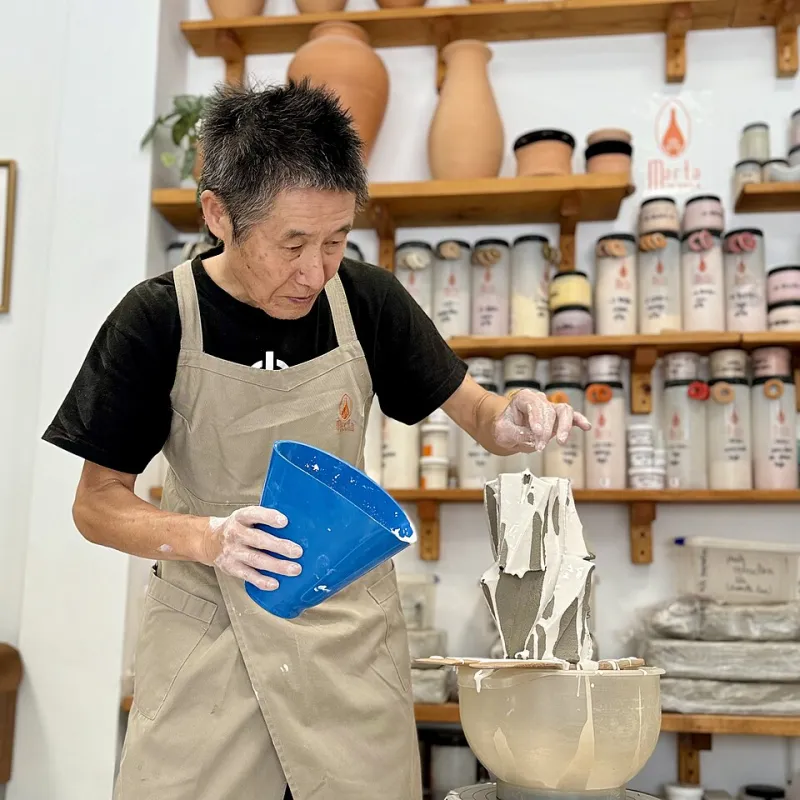
Photo: Marta Cerámica, CC0, via Wikimedia Commons
Marco Telles spent four years building what looked, from the outside, like a pretty solid creative career. He had a ceramics studio in Portland, a respectable Instagram following, commissions from local restaurants, and a side income teaching weekend workshops. He was, by most metrics, doing fine.
Then he watched a 40-second video of a Nagasaki potter named Kenji Mori centering clay on a wheel, and something shifted.
"It wasn't the technique," Marco says now, sitting in the small apartment he rents on the slopes of Inasayama, about a ten-minute walk from Mori's studio. "It was the attention. The way he was paying attention to the clay. I'd never seen anything like it. I realized I'd been making things, but I hadn't been paying attention."
That was three years ago. Marco is still here.
The Pipeline Nobody's Talking About
Marco isn't alone. Over the past several years, a quiet but growing movement of American artists, musicians, woodworkers, and instrument-makers has been making its way to the Inasayama region of Nagasaki to study traditional crafts under Japanese master artisans. They're not coming for a two-week cultural immersion or a curated workshop experience. They're coming for the real thing — the years-long, relationship-based apprenticeship model that has been the backbone of Japanese craft culture for centuries.
It's a model that has almost no equivalent in the American creative economy. We have MFA programs and online courses and YouTube tutorials and accelerator cohorts, but we don't really have apprenticeship — the kind where you spend the first year learning how to clean the studio correctly, where the master barely speaks to you for months, where progress is measured in decades rather than semesters.
For a certain kind of American creative, that's exactly the point.
"Everything at home is optimized for speed," says Jordan Kessler, a furniture maker from Asheville, North Carolina, who has been studying woodworking under a third-generation craftsman in a village just outside Nagasaki for two years. "Learn faster, produce more, build your brand. I was exhausted by it. I wanted to learn something the slow way and see what that felt like."
What the Slow Way Actually Looks Like
It looks, at first, like a lot of sweeping.
Every American who has gone through a traditional Japanese apprenticeship in the Inasayama region describes a similar early phase: months of peripheral tasks that seem to have nothing to do with the craft itself. Cleaning tools. Organizing materials. Observing without being invited to participate. Making tea.
For people who have been conditioned by American creative culture — where output is identity and visibility is currency — this phase is genuinely difficult.
"I had a minor breakdown around month three," admits Caitlin Park, a musician from Chicago who is now in her second year studying shamisen under a master in Nagasaki. "I kept thinking, I gave up my apartment for this? But my teacher told me something that I've been thinking about ever since. He said, 'You're not learning the instrument yet. You're learning how to be a student.' I didn't know I needed to learn that."
The breakthrough, when it comes, tends to be less about skill acquisition than about a fundamental shift in how these Americans relate to their own creative practice.
Marco describes throwing pots now with a quality of presence that he couldn't have articulated before Nagasaki. Jordan talks about developing what he calls "wood sense" — an intuitive understanding of how a particular piece of timber wants to be worked — that no manual or course could have given him. Caitlin has started hearing the shamisen in a way that has changed how she listens to every other instrument.
The Thing American Creative Education Can't Replicate
Talk to enough of these cultural transplants and a consistent theme emerges: what they're getting in Nagasaki isn't primarily technical knowledge. It's a relationship with difficulty that American educational models tend to short-circuit.
In the U.S., struggle in a learning context is usually treated as a sign that something is wrong — with the curriculum, with the teacher, or with the student. It's a problem to be solved. In the apprenticeship model thriving around Inasayama, difficulty is the curriculum. The discomfort is the lesson.
"My teacher never explains why we're doing something a certain way," Jordan says. "You just watch, and you do it, and eventually your hands start to understand what your brain couldn't. That's a completely different relationship with knowledge than anything I experienced in school."
This approach has a name in Japanese craft culture: minarai, or "learning by watching." It's the understanding that certain kinds of knowledge can't be transmitted verbally — they can only be absorbed through sustained, attentive observation over time. It's the opposite of a tutorial.
The Challenges Nobody Posts About
Life as a craft apprentice in Nagasaki isn't all meditative pottery sessions and mountain views, and the Americans who've made the move are refreshingly honest about the hard parts.
Language is a constant challenge. Most of the master artisans in the Inasayama region speak little or no English, which means that for the first year or two, communication happens almost entirely through gesture and demonstration. Several apprentices described this as both the hardest and most transformative aspect of the experience.
"You can't hide behind words," Caitlin says. "You have to actually show that you understand something. That's terrifying and also incredibly clarifying."
There's also the financial reality. These apprenticeships are largely self-funded, which means most participants have burned through savings, taken on part-time work, or found creative ways to maintain some income remotely. The romantic image of the devoted student learning at the master's feet tends to skip over the part where the devoted student is also anxiously refreshing their bank app.
And then there's the loneliness. Nagasaki is a warm and welcoming city, but building real community as a foreigner takes time — more time than most Americans are used to giving.
"There were months where I genuinely wondered if I'd made a mistake," Marco admits. "And then I'd make something in the studio that I couldn't have made before, and I'd understand why I was still here."
What They're Bringing Back
Some of these Americans will stay in Nagasaki indefinitely. Others are already planning their return, carrying with them not just refined skills but a fundamentally different orientation toward making — slower, more attentive, less anxious about output.
What they bring back matters. Not just for their own practices, but for a creative culture that has been running on fumes, mistaking speed for vitality and visibility for meaning.
Nagasaki's master artisans have been quietly holding a different standard. And a growing number of Americans are making the trip to find out what it feels like to be held to it.