The Mountain That Taught Japan to See: How Inasayama Rewired the Way Artists Understood Space
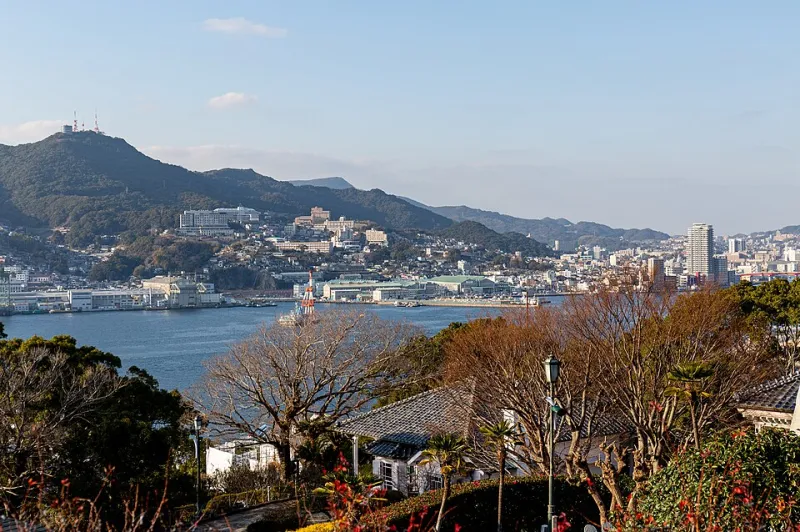
Photo: Balon Greyjoy, CC0, via Wikimedia Commons
There's a particular moment, if you time it right, when you're standing near the summit of Inasayama and the whole geometry of Nagasaki opens up below you. The harbor curves like a brushstroke. The buildings stack in receding layers. Ships leave trails that seem to vanish into a single invisible point on the horizon. It looks, honestly, like someone designed it to be a lesson in perspective.
As it turns out, for a generation of Japanese artists, that's almost exactly what it was.
A View That Changed Everything
Nagasaki has always been Japan's most outward-facing city. During the Edo period, when the country sealed itself off from virtually all foreign contact, this port remained the one sanctioned window to the outside world. Dutch and Chinese traders passed through. Western books arrived. And with those books came something that quietly unsettled the foundations of Japanese visual art: European linear perspective.
But here's the thing most art history courses skip over — the Japanese artists who first grappled with these new spatial ideas weren't just studying Dutch engravings in a workshop somewhere. Many of them were climbing Inasayama.
The mountain's position directly above the harbor created something almost pedagogical in its clarity. From that height, you could see converging lines. You could watch the way distance compressed and layered the city below. You could observe, with your own eyes, the phenomenon that European painters had been codifying for centuries. Inasayama wasn't just scenery. For artists in Nagasaki, it was a living diagram.
Rangaku, Art, and the Harbor Below
The movement known as Rangaku — literally "Dutch learning" — brought Western science, medicine, and eventually artistic technique into Japan through Nagasaki's Dejima trading post. Among the visual artists drawn into this current was Shiba Kōkan, an 18th-century painter and printmaker who became one of the first Japanese artists to seriously experiment with Western-style perspective and copper engraving.
Kōkan actually visited Nagasaki. He wrote about the experience at length. And scholars who've studied his work note a marked shift in how he rendered landscapes after that trip — a new attention to recession, to aerial perspective, to the way light behaves differently at distance. It's not a stretch to connect that shift to the views he would have encountered from Inasayama's slopes.
Contemporary artist and art historian Mika Tanabe, who splits her time between Nagasaki and Tokyo and has spent years researching Edo-period visual culture, puts it plainly: "The mountain gave artists permission to look differently. When you're standing up there, the city arranges itself in a way that almost argues for depth. You don't need a textbook. The landscape makes the argument itself."
Meiji Acceleration and the Mountain's Second Act
If the Edo period planted the seeds, the Meiji era — Japan's rapid modernization after 1868 — brought the full bloom. Western architecture, photography, and print culture flooded in. Japanese artists were suddenly navigating two entirely different visual traditions simultaneously, and Nagasaki, as ever, was on the front lines.
The Meiji-period yōga painters (those working in Western oil techniques) found Inasayama irresistible as a subject. Archival works held in Nagasaki's prefectural collections show the mountain rendered from below, from the harbor, from the city streets — but also used as the vantage point itself, the eye from which Nagasaki is observed and organized on canvas.
What's striking about these works, when you see them side by side, is how the mountain view seems to have functioned almost as a compositional grammar. The harbor-from-above format — ships in the foreground, city in the middle distance, sea and sky collapsing toward the horizon — appears again and again. It became a kind of visual signature for Nagasaki's artistic identity.
Architects were paying attention too. The layered, terrace-style residential construction that characterizes Nagasaki's hillside neighborhoods — so different from the flat-grid logic of cities like Osaka — reflects an aesthetic shaped by the experience of looking down at the city as much as moving through it. The mountain trained eyes to think in elevation.
What Contemporary Artists Are Finding in the Archives
Today, a small but dedicated group of artists and researchers is returning to these historical works with fresh eyes. Some are using digital tools to reconstruct the exact sightlines from Inasayama that Edo and Meiji artists would have had, comparing archival paintings to contemporary photographs taken from the same GPS coordinates.
The results are striking. In several cases, the compositional choices in historical paintings align almost perfectly with what you'd see standing at specific points along the mountain's trails. These weren't idealized landscapes — they were observed ones, carefully translated from a real and specific place.
Nagasaki-based painter Kenji Furuya, whose work blends traditional ink techniques with contemporary spatial concepts, has been studying these alignments for several years. "There's a precision in those old works that I think gets underestimated," he says. "People assume the Edo masters were working from imagination or convention. But some of them were standing right there, looking at exactly what we can still see today. That continuity is kind of mind-blowing."
Furuya's own paintings deliberately reference those historical vantage points — not as nostalgia, but as a way of staying in conversation with a long, unbroken thread of observation.
Why This Matters to American Art Lovers
For US audiences who've grown up thinking of Japanese art primarily through the lens of Hokusai's Great Wave or the stylized flatness of woodblock prints, the Inasayama story offers a genuinely surprising counter-narrative. Japanese artists were wrestling with the same questions about space, depth, and representation that European painters had been wrestling with for centuries — and they were doing it, at least in part, by standing on a mountain and looking hard at a harbor.
That's a deeply human story. It's the story of geography shaping thought, of a place becoming a teacher. And it's one that's still accessible — because the mountain is still there, and the view from the top is still, more or less, what it's always been.
If you ever find yourself on Inasayama at dusk, watching the city lights begin to flicker on below and the harbor go silver in the fading light, you'll understand something without needing it explained. The mountain has a way of organizing the world for you. It did it for artists two and three centuries ago. It'll do it for you too.
Some classrooms don't have walls. Some of the best ones are just a mountain, a view, and the willingness to really look.