Seeing in a New Frequency: How Nagasaki's Artists Are Changing the Way Americans Understand Color
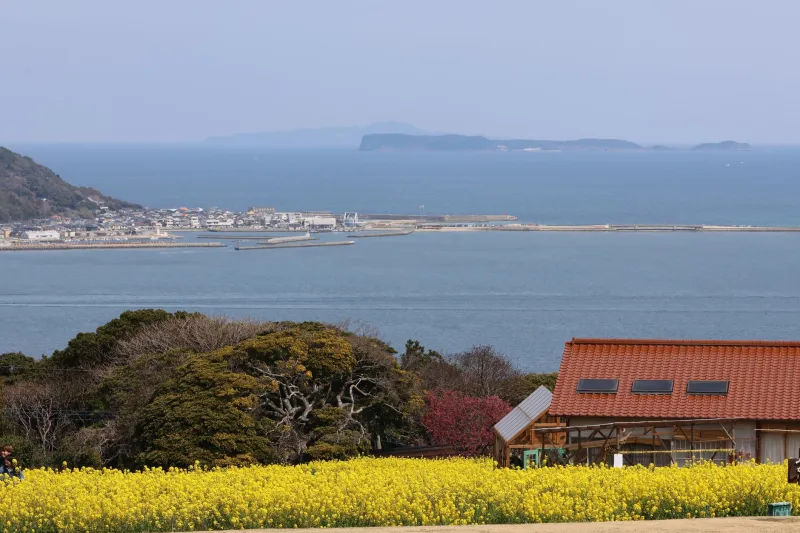
There's a moment, usually around late afternoon, when the light on Inasayama does something that's genuinely hard to explain. It doesn't just fall — it settles. The harbor below catches it first, softening it through layers of sea mist, and by the time it climbs the slope and reaches the studios tucked into the mountain's mid-elevation, it has transformed into something almost amber, almost violet, almost neither. Artists who've experienced it describe a kind of color that doesn't have a Pantone number. And that, it turns out, is exactly the point.
For a growing number of visual artists — many of them with roots in New York, Los Angeles, and Chicago — that indescribable quality of light is the whole reason they moved here.
When Western Color Theory Hits a Wall
Most American art students are trained in a color framework that goes back centuries. The Munsell system, the color wheel, Josef Albers' interactions of hue — these are the foundational tools. They're rigorous, useful, and almost entirely developed in landlocked European and North American contexts. What they don't account for is what happens when light passes through salt-heavy maritime air, bounces off a volcanic hillside, and filters through the particular cloud formations that Nagasaki's geography produces almost daily.
"I came here thinking I understood how light worked," says Maya Thornton, a painter originally from Portland, Oregon, who relocated to Inasayama four years ago after a residency brought her to Nagasaki. "Within two weeks I was repainting everything. The shadows here aren't gray. They're not even close to gray. They have color in them that I had no name for."
Thornton is part of a loose but expanding community of foreign and Japanese artists who've made Inasayama their base specifically to study this phenomenon. They're not a formal collective — there are no manifestos or membership dues — but they share studio spaces, compare notes, and increasingly, share their findings with institutions back in the States.
The Geography Behind the Glow
Nagasaki sits in a natural bowl formed by surrounding mountains and opens toward the sea through a narrow harbor channel. That topography does something unusual to light. Rather than spreading evenly, it gets funneled, reflected off water, and then diffused by the persistent coastal haze that rolls in from the East China Sea. Inasayama, rising steeply above the city, catches this light at angles that shift dramatically depending on season and time of day.
Photographer Jin Watanabe, who grew up in Nagasaki and studied visual arts in San Francisco before returning home, has spent the last decade documenting these shifts. His ongoing series, Refraction Diaries, catalogs the same hillside viewpoint photographed at the same time of day across every month of the year. The results are almost unbelievable side by side — the same physical location reads as warm gold in November, a cool silver-blue in June, and something closer to deep rose in early March.
"People in the US see these and think I've color-graded them heavily in post," Watanabe says with a laugh. "I barely touch them. That's just what the mountain gives you."
His work has been exhibited in galleries in Seattle and Boston, and he's been invited to speak at two university art programs this year about what he calls "geographic color" — the idea that location isn't just a backdrop for art, but an active ingredient in how color is perceived and produced.
Installation Art That Makes You Doubt Your Own Eyes
Perhaps no one in the Inasayama community is pushing this further than Ren Asakura, a Japanese installation artist whose large-scale light works have started attracting serious attention from American museum curators. Asakura's installations don't use projected color — they use the mountain's actual ambient light, redirected and concentrated through custom-built reflective panels and translucent screens.
The effect is disorienting in the best possible way. Visitors walking through one of his pieces report seeing colors shift as they move through the space, not because anything in the installation changes, but because their angle to the light source changes. It's a deliberate lesson in the subjectivity of color perception — something Albers wrote about theoretically, but that Asakura makes viscerally physical.
"I want people to leave uncertain," Asakura says. "Certain that what they saw was real, but uncertain about what it was. That gap is where interesting thinking happens."
Two of his pieces are currently being considered for permanent installation at cultural institutions in the US, a development that would have seemed unlikely even five years ago.
Ripples in American Design and Education
The influence of this Nagasaki-based thinking is already showing up in unexpected places stateside. A design program at a California university recently updated its color theory curriculum after a faculty member spent a semester in residence on Inasayama. The revision added an entire module on environmental and atmospheric color — the idea that color isn't a fixed property of objects but a relationship between light, surface, and observer.
Several interior designers working in the Pacific Northwest have also cited trips to Nagasaki as transformative for their practice. One Seattle-based designer described returning home and immediately stripping overly saturated palettes from three active projects. "I'd been fighting the light in those spaces instead of working with it," she explained. "Nagasaki showed me that."
Online, the conversation is growing too. Short-form video content featuring Inasayama's light conditions — filmed by artists, tourists, and local residents alike — regularly circulates through design and photography communities, sparking genuine debate about whether Western color education is missing something fundamental.
Why It Matters Beyond the Canvas
What's compelling about all of this isn't just that the art coming out of Inasayama is visually striking — though it is, consistently. It's that the artists working here are asking a question that goes deeper than technique: How much of what we see is actually what's there, and how much is what we've been taught to expect?
That's a question with implications that stretch well beyond painting or photography. It touches on perception science, on cross-cultural communication, on the way we design spaces where people live and work. And it's being asked, with real rigor and real beauty, from a hillside above a harbor in southwestern Japan.
If you've ever stood in a gallery and thought a painting's colors looked somehow alive — like they were doing something you couldn't quite track — there's a decent chance the artist spent time somewhere like Inasayama. Learning to see in a frequency the textbooks forgot to mention.