One Camera, No Crowd: How Nagasaki's Classical Musicians Are Winning Over Gen Z One Pause at a Time
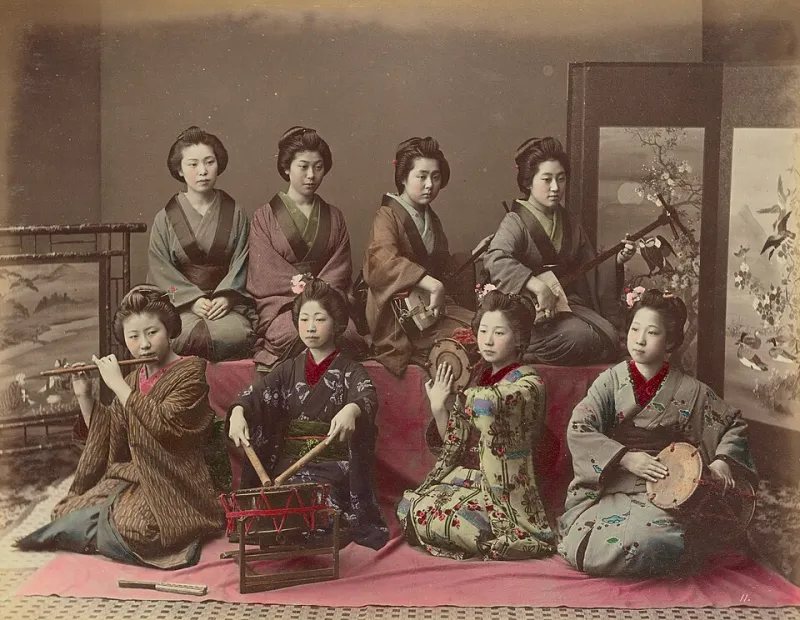
Photo: Kusakabe Kimbei, Public domain, via Wikimedia Commons
There's a video that's been making quiet rounds in certain corners of the internet. No flashy thumbnail. No algorithm-bait title. Just a woman seated beside a rain-streaked window somewhere in Nagasaki, a shamisen resting across her lap, and four full seconds of absolute silence before she plays a single note. By the time the video ends — barely six minutes later — the comments are flooded with Americans typing things like I didn't realize I needed this and why does this feel like therapy?
That musician is Tanaka Yui, and she has no manager, no record deal, and no interest in either. What she does have is a growing audience of Gen Z listeners in the US who found her the same way they find most things that actually matter to them: by accident, through a share, through a feeling.
Yui is not alone. Across Nagasaki — and especially in the quieter neighborhoods that climb toward Inasayama — a loose community of classically trained and traditionally rooted musicians has been deliberately pulling away from the polished concert experience. They're not doing it out of budget constraints. They're doing it on purpose.
The Anti-Performance Performance
To understand what's happening here, it helps to understand what these musicians are pushing back against. The past decade has seen classical music institutions pour enormous resources into "making classical cool" — slick livestreams, LED-lit stages, social media campaigns featuring orchestras in streetwear. The results have been mixed at best. Younger audiences, particularly in the US, have largely shrugged.
What seems to be landing instead is something almost opposite. Musicians like Yui, koto player Ishikawa Ren, and the small ensemble known informally as Kūhaku (which translates loosely as "blank space") are stripping everything back. Single fixed camera. Natural light. Ambient room sound. And — crucially — the silences left fully intact.
"Most recordings treat silence like a mistake," Ishikawa told us during a conversation over green tea in his modest studio near the base of Inasayama. "An editor's job is to clean it up, tighten it. But silence is where the listener does their own work. If you cut it out, you've taken something from them."
This philosophy has a name in Japanese aesthetics — ma — and it refers to the meaningful pause, the negative space that gives form to what surrounds it. It's a concept deeply embedded in traditional Japanese arts, from calligraphy to garden design to Noh theater. What's new is the way these musicians are consciously translating ma into the grammar of online video.
Why It's Hitting Different for American Audiences
Spend any time in the comment sections of these videos and a pattern emerges fast. American viewers — and Gen Z ones in particular — aren't engaging with this music the way they might engage with, say, a viral piano cover. They're not sharing it ironically or sampling it for a meme. They're describing it in the language of mental health. Grounding. Decompressing. Actually present for once.
That tracks with what researchers and cultural commentators have been noting about the youngest American adults: a generation raised on algorithmic acceleration is increasingly hungry for content that doesn't demand anything from them. The endless scroll has created, paradoxically, an appetite for stillness.
"There's a real fatigue with content that's trying too hard," says one US-based music journalist who covers the intersection of streaming culture and global sounds. "When something shows up that isn't performing for you — that's just existing — it stands out. It feels honest in a way that a lot of produced music doesn't anymore."
Nagasaki's musicians seem to have arrived at this insight not by studying American consumer trends, but simply by following their own instincts about what music should feel like. The result is a kind of accidental resonance across a very large cultural gap.
The Inasayama Effect
It would be easy to frame this as a purely digital story — musicians adapting to platform culture — but spend a little time in Nagasaki and you start to understand how deeply the place itself is shaping the sound.
Inasayama sits above the city like a slow exhale. The mountain has long been associated with perspective — both literal, given its famous nighttime views, and something harder to quantify. Artists, monks, and wanderers have been drawn to its slopes for generations, and there's a quality to the light and air up there that Nagasaki locals describe with a kind of quiet pride.
Many of the musicians in this community either live near the mountain or make regular trips up its trails as part of their practice. Kūhaku records some sessions outdoors, capturing the ambient sounds of wind through cedar and the distant harbor. Yui says her compositions often begin as walks rather than written scores.
"I hear something on the mountain and I try to remember the shape of it," she explained. "Not the melody exactly. The feeling of the pause before the wind changes."
That sensibility — hyper-local, rooted in a specific landscape — comes through in the recordings in ways that are difficult to articulate but easy to feel. American listeners who have never been to Nagasaki are somehow picking up on it.
Lo-Fi as a Conscious Choice
One of the more counterintuitive aspects of this movement is the deliberate embrace of lo-fi recording quality. In an era when home studio technology has made pristine audio accessible to almost anyone, these musicians are choosing not to use it.
Room noise stays in. The occasional creak of a chair, a distant temple bell, the hiss of rain on glass — none of it gets scrubbed. The effect is less like listening to a recording and more like sitting in the room.
"High-definition audio is amazing technology," Ishikawa said, with a small smile that suggested he wasn't entirely sold on it. "But it can make music feel like a product. We're not making products."
This aesthetic has found a surprisingly receptive audience among American listeners who grew up on lo-fi hip-hop study streams and bedroom pop. The sonic texture of imperfection has become, for this generation, a signal of authenticity — and Nagasaki's classical musicians, whether they know it or not, are fluent in that language.
What Comes Next
None of the musicians in this community seem particularly interested in scaling up. There are no plans for US tours, no label conversations, no pivot to merch. A few have politely declined collaboration requests from producers who wanted to "clean up" their recordings for wider release.
For now, the work stays small, stays local, and stays honest. The videos accumulate views slowly, steadily, without any single viral moment pushing them forward. Followers find them, then stay.
Somewhere on a hillside above Nagasaki harbor, Tanaka Yui is probably composing something right now — not writing it down, just walking the shape of it through her mind, letting the pauses do their work.
When she finally records it, some 22-year-old in Portland or Austin will stumble across it at 2am, put in their earbuds, and sit very still for six minutes.
And that will be enough.