Off the Algorithm: Why Nagasaki's Jazz Dens Are the Antidote to the Playlist Era
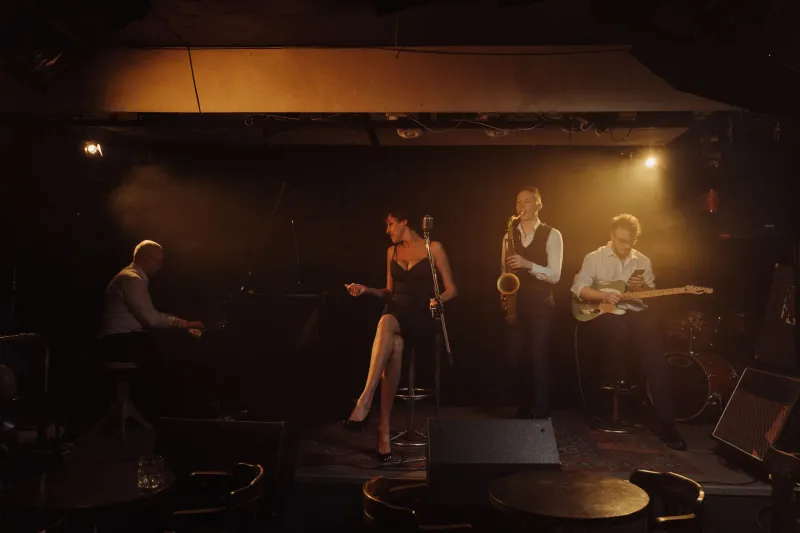
There's a bar in Nagasaki that doesn't have a sign out front. No Yelp page, no Instagram handle pinned to the door. The only way most people find it is because someone who loves them tells them where to go. Inside, on a Tuesday night in late October, a quartet is playing — and nobody in the room is looking at their phone.
This is not an accident.
The City That Sound Built Differently
Nagasaki has always had a complicated relationship with noise. A port city shaped by centuries of foreign trade, wartime silence, and postwar reconstruction, it carries an acoustic memory that most Japanese cities don't. The hills absorb sound differently here. The harbor throws it back. And the neighborhoods that grew up around the old industrial waterfront — cramped, layered, full of concrete stairways and recessed alleyways — create pockets of near-perfect acoustic intimacy that no studio engineer could fake.
It's that geography, in part, that drew venue owner Kenji Murakami to open his jazz room, Kasumioto (loosely: "haze sound"), in a converted shipping office near the Dejima district about seven years ago. "I didn't plan for it to become what it became," he says, leaning against the bar after a set. "I just wanted a room that sounded honest."
Honest. That word comes up a lot in conversations about Nagasaki's jazz scene.
What American Listeners Are Running From
For a growing number of American musicians and music fans making their way to Japan — not just Tokyo, but further, deeper — the appeal of places like Kasumioto is inseparable from what they're escaping back home. The US streaming economy has done something strange to listening culture. Algorithms optimize for retention, not revelation. Playlists are engineered to keep you from leaving, not to take you somewhere new. Live music venues in American cities increasingly book based on social media follower counts rather than musical substance.
Saxophonist Dana Whitfield, from Portland, Oregon, came to Nagasaki last spring as part of a self-funded residency she organized after burning out on the Portland scene. "I was playing three gigs a week and feeling nothing," she says. "Every venue wanted the same energy, the same volume, the same arc. It was like performing inside a template."
She found Kasumioto through a message board — old school, she admits — and sat in with the house quartet on her second night in the city. "The audience was so quiet," she recalls, and she means that as the highest possible compliment. "Not politely quiet. Actively quiet. Like they were leaning into the music with their whole bodies."
Restraint as a Creative Philosophy
What distinguishes Nagasaki's jazz culture from what you'd find in, say, a Shinjuku jazz bar or a Brooklyn venue isn't just the room size or the crowd. It's an aesthetic philosophy that prizes restraint — the pause, the half-finished phrase, the note that doesn't resolve — in a way that connects directly to broader Japanese artistic sensibilities without being self-consciously "traditional."
Murakami is quick to push back on the idea that this is just ma (the Japanese concept of negative space) applied to music. "People want to make it exotic," he says, a little drily. "But it's simpler than that. If you play less, the audience has to participate. They have to bring something. That's the deal we make."
That deal creates something rare: genuine co-authorship between performer and listener. American visitors describe it as the closest thing to a meditation experience they've had in a music context — but without any of the self-help packaging.
The Room Where Improvisation Has Stakes
At Kasumioto and the handful of similar venues scattered through Nagasaki's older neighborhoods, improvisation isn't just a technique — it's a social contract. Performers are expected to read the room, adjust mid-phrase, and respond to the specific emotional weather of a specific Tuesday night with a specific collection of strangers. There's no setlist safety net.
For visiting American musicians, this can be terrifying at first. Jazz guitarist Marcus Osei, who spent three weeks in Nagasaki last winter, describes his first sit-in as "the most exposed I've felt on a bandstand since I was a teenager." Without the buffer of a loud crowd or a familiar club environment, every choice was audible. Every hesitation, every recovery, every moment of genuine discovery.
"I played things I didn't know I knew," he says. "And I played some things that didn't work at all, and nobody left, and nobody pulled out their phone, and the pianist just looked at me and smiled. That's it. That was the whole experience."
He's going back in the fall.
Beyond the Music: What Nagasaki Does to You
It's hard to talk about the jazz scene here without talking about the city itself. Nagasaki doesn't let you stay on the surface. Its history is too layered, its topography too demanding, its atmosphere too specific. The hills of Inasayama, visible on clear nights from the waterfront streets where most of these venues cluster, cast a kind of long shadow over the city's creative life — not oppressively, but with weight. With consequence.
American visitors who've spent time in Tokyo or Kyoto often describe Nagasaki as the first place in Japan where they felt truly disoriented in a productive way. The city resists easy consumption. And so, it turns out, does its jazz.
"There's something about a place that has grieved," Dana Whitfield says, carefully. "It changes what you think music is for."
How to Find It
The venues don't advertise heavily, and that's part of the point. A few practical notes for the curious: the area around Dejima and the older Shianbashi entertainment district has the highest concentration of small live music rooms. Weeknights are often better than weekends — smaller crowds, longer sets, more willingness from musicians to experiment. Arrive early, order something, and don't rush the room. Most importantly, leave your earbuds at the hotel.
The music will find you if you let it. That's the whole idea.